
A Schedule 1 name mismatch almost always traces back to one thing: the business name on your Form 2290 does not match the name the IRS has on file for your EIN. The fix is to confirm the exact legal name from your IRS records, enter it the same way on the return and on Schedule 1, and resubmit. If you file with us, you can do that on our Form 2290 e-file page, where the single-vehicle filing is $6.90.
This guide is for owner-operators, fleets and tax preparers who are filing the 2290 excise tax return and need a stamped Schedule 1 without a rejection loop.
TL;DR
- The IRS checks your EIN and name control together. If they do not match its records, the e-filed return is rejected, so no stamped Schedule 1 is issued.
- The name control is created from the legal name on Form SS-4 when the EIN was assigned. Use that legal name, never a DBA.
- Single-member LLCs must file the 2290 excise tax in the LLC's name and EIN, not the owner's name and Social Security number.
- Confirm the exact name with your CP575 notice, a digital CP575 or Letter 147C before you resubmit.
- Name errors are not a reason to check the Amended Return box. That box is for weight increases and mileage overruns only.
Table of Contents
- What a name mismatch on Schedule 1 really means
- Where the mismatch usually comes from
- How to check the name before you resubmit
- Fixing the mismatch before acceptance
- If the return was already accepted
- Fleets and tax preparers: keeping many names straight
- What you need on the desk before you file again
- Filing your 2290 excise tax return with TruckTaxPro
- Our perspective
- FAQ
- Sources
What a name mismatch on Schedule 1 really means
Schedule 1 is the proof-of-payment page the IRS stamps after it accepts your Form 2290. It is what you show your state DMV or registration office to register or renew the truck. The name and address on it must be the same as on the Form 2290 itself, and the EIN must match page 1 of the return, according to the IRS instructions for Form 2290.
So a "mismatch" usually shows up in one of two ways:
- A rejection at e-file. The return never reaches acceptance, so you never receive a stamped Schedule 1. This is the common case.
- A Schedule 1 that does not match your other paperwork. The name printed on it differs from the name on your registration, insurance or EIN letter, because the name was typed differently than the IRS has it.
The first case is an automated data check. IRS Publication 4163 explains that the EIN and Name Control are validated against the IRS National Account Profile database, and a Name Control mismatch is among the most common causes of e-file rejection. It is not a judgment about your tax. It is a comparison of two values, which is why correcting them and resubmitting is usually enough.
What a name control is
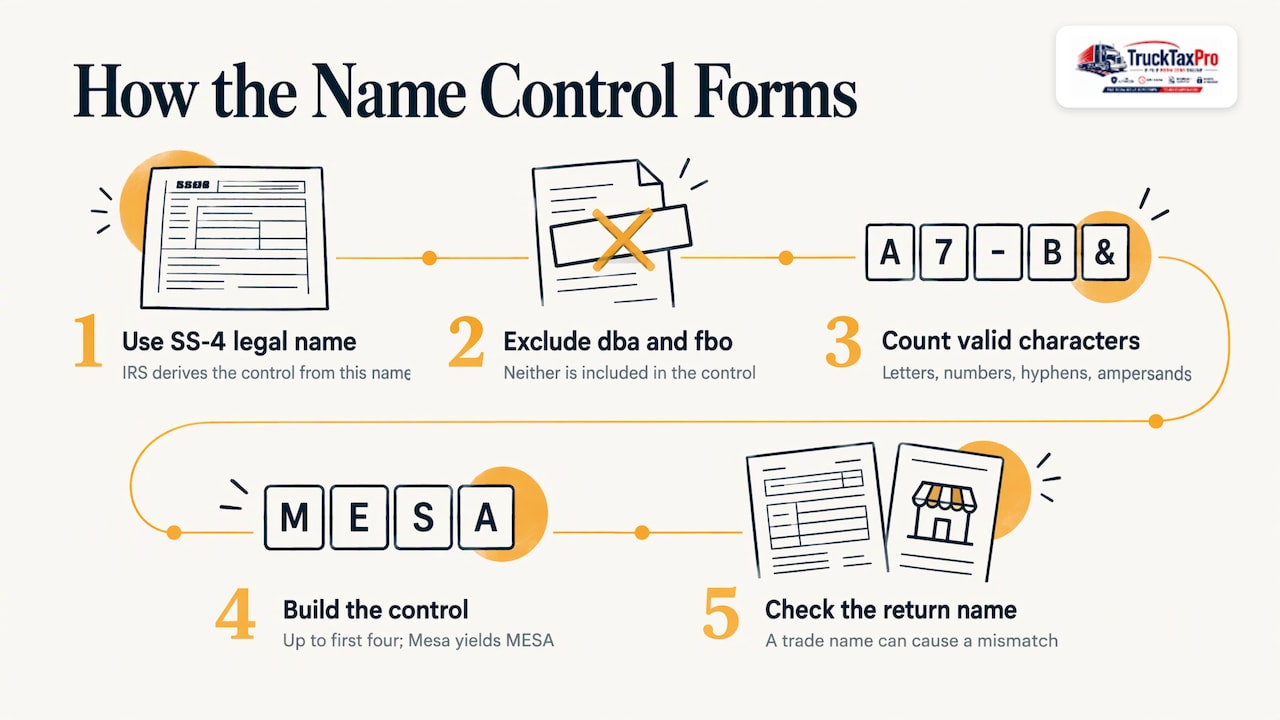
The name control is a short code the IRS derives from your business name. For a business, it is generally up to the first four alphanumeric characters of the name. Only letters, numbers, hyphens and ampersands count, and "dba" or "fbo" are never included, per Publication 4163. The IRS creates it from the legal name on Form SS-4 when it assigns your EIN, as explained on its name control page.
That means a trucking company called "Mesa Hauling LLC" on the SS-4 carries a name control built from "MESA". If you type "Smith Trucking dba Mesa Hauling" on the return, the control no longer lines up.
Where the mismatch usually comes from
Most mismatches fall into a handful of patterns. Find yours in the table before you touch the return.
| What happened | Why it breaks the match | What to use instead |
|---|---|---|
| You typed the trade name (DBA) as the business name | The IRS built the name control from the legal name, not the trade name | The legal name from SS-4 line 1 |
| Single-member LLC filed under the owner's name or SSN | The LLC is a separate entity for 2290 excise tax purposes | The LLC's name and the LLC's EIN |
| Name changed after the EIN was issued | IRS records still show the original name | The name on your IRS record, until the IRS updates it |
| Brand-new EIN filed too early | The name control is not yet established in IRS systems | Wait the period the IRS specifies, then file |
| Typo, extra punctuation or abbreviated word | The characters feed the name control | The name exactly as on your CP575 or Letter 147C |
| Wrong EIN entered (digits transposed, or an old EIN) | The EIN and name pair fails to match any record | The 9-digit EIN from your IRS letter |
Single-member LLCs are the classic trap
Owner-operators often run a single-member LLC and file personal taxes under their own Social Security number. For Form 2290 that habit causes rejections. The Internal Revenue Manual says that for certain excise taxes, including Form 2290 liabilities incurred after January 1, 2008, a single-member LLC is treated as a separate entity and reports in the name and EIN of the LLC, not the owner's TIN. If your 2290 went in under your own name with the LLC's EIN, or the reverse, expect a mismatch.
A new EIN needs time
If you just got your EIN, wait. The IRS tells truckers that you may e-file four weeks from the date the EIN was assigned, so the name control is established. Filing earlier is a reliable way to get a rejection that has nothing to do with your typing.
How to check the name before you resubmit
The IRS Form 2290 e-file page says your e-file name control must match your EIN name. The Form SS-4 instructions say line 1 must show the legal name exactly as it appears on the legal document, the trade name goes on line 2, and the legal name (or elected trade name) should be used consistently on all returns.
To see what the IRS actually has, use one of these documents:
- CP575 notice. The letter the IRS sent when it assigned the EIN.
- Digital CP575. The IRS says you can download an EIN Verification Notice in your Business Tax Account, usable in place of the original CP575 or Letter 147C, as described on its EIN page.
- Letter 147C. Request it by calling the business and specialty tax line at 800-829-4933.
If you do not remember your number at all, our guide on how to find your EIN walks through where it is recorded.
Note what IRS Publication 4900 says: the e-file provider does not have your name control information, so you must verify it against your EIN letter. Pull the letter first, then enter the name character for character: same spelling, same suffix such as LLC or Inc., no added trade name.
A quick worked example
Say Maria Lopez operates as "Lopez Express" but her SS-4 lists "Maria Lopez Transport LLC". Her EIN letter shows the LLC name. Her return was rejected after she typed "Lopez Express". The fix: enter "Maria Lopez Transport LLC" with the LLC's EIN on the return. Schedule 1 will then carry that same name and address, as the instructions require.
Fixing the mismatch before acceptance
If the return was rejected, nothing was accepted, so you are correcting a draft and not amending a filed return. The sequence:
- Read the reject message. Note whether it points to the EIN, the name control or both.
- Confirm the EIN. The IRS guidance on name controls says to first make sure the EIN is correct, then review the Business Name Control rules.
- Match the name to your IRS letter. Use the CP575, digital CP575 or Letter 147C.
- Correct and retransmit. Fix both values in the return and send it again.
- If the reject persists, call the e-Help Desk. The IRS directs persistent EIN or name control rejects to 866-255-0654.
There is no extra tax from this step. You are fixing identification data, not changing the vehicles or weight.
If the return was already accepted
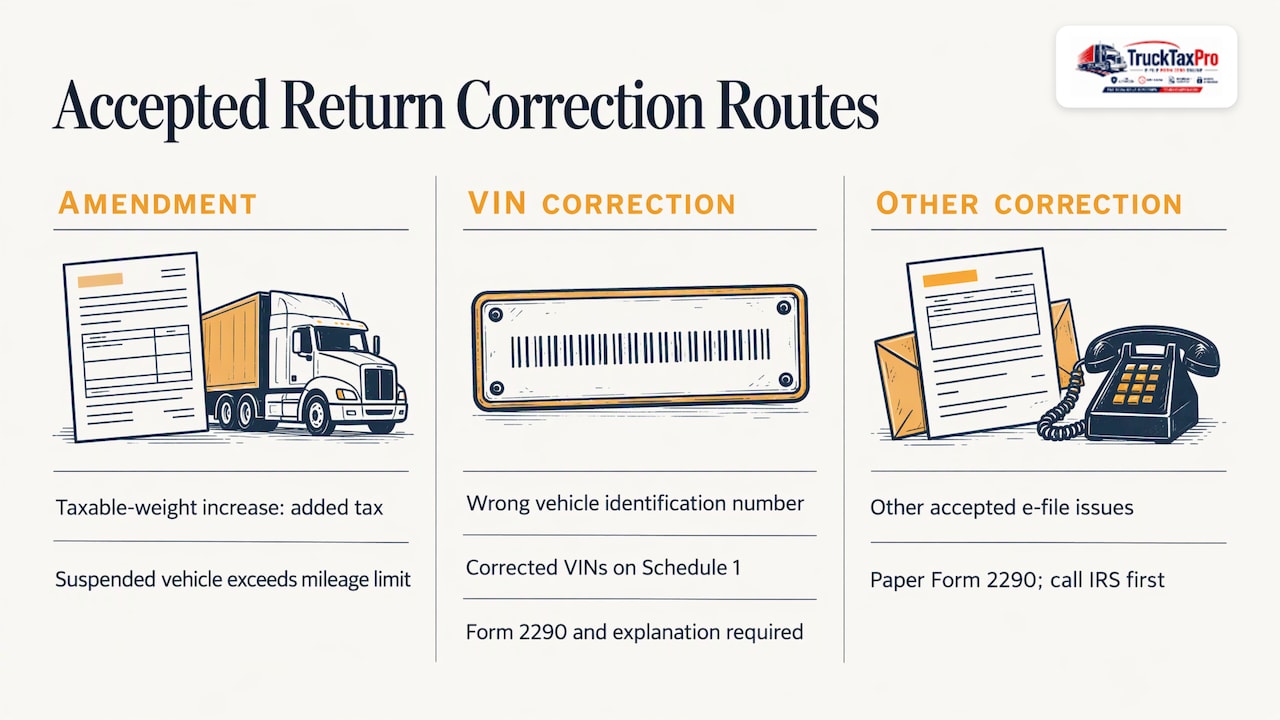
This is where people reach for the wrong button. Per the Form 2290 instructions, the Amended Return box is for only two reasons: additional tax from a taxable gross weight increase, or suspended vehicles that exceeded the mileage use limit. A name issue is neither.
The VIN Correction box is separate and applies when a vehicle identification number was wrong. It requires the corrected VINs on Schedule 1, the Form 2290 for the tax period being corrected, and an explanatory statement. If your real problem is a wrong VIN, see our guide to a 2290 rejected due to VIN, or file a VIN correction directly. Weight or mileage changes go through an amendment.
For anything else on an accepted e-filed return, the IRS FAQ for truckers says corrections beyond weight, mileage and VIN are made on a paper Form 2290 mailed to the address in the instructions. Because name and EIN questions on an accepted return depend on your specific records, call the IRS Form 2290 line before you mail anything: 866-699-4096, Monday to Friday, 8:00 a.m. to 6:00 p.m. Eastern, with Spanish-speaking assistors, per the Form 2290 instructions. For an EIN-related correction, our post on changing an EIN on Form 2290 explains what can and cannot be fixed.
If you are unsure whether your filing was accepted at all, check your 2290 status and find your Schedule 1 there.
Fleets and tax preparers: keeping many names straight
A mismatch is more costly at scale. One wrong name copied across a client list means many rejected returns the week registrations are due.
Set one master record per entity. For each client or company, store the legal name from the EIN letter, the EIN, and the address once, and reuse it. Do not retype it per truck.
Keep one entity per return. Multiple Forms 2290 can be filed for the same tax period, according to IRS Publication 4164. Group vehicles under the entity that owns them, not under whichever name a driver uses day to day.
Get authorization before you speak for a client. A preparer who needs to discuss entity information or obtain Letter 147C must hold Form 2848 or Form 8821 from the client. The IRM says a taxpayer or authorized representative can call to verify an EIN and request Letter 147C, which is faxed or mailed to the address of record, with delivery expected in 10 to 14 business days. Start early, because the original CP575 cannot be duplicated.
Keep your records consistent across systems. The same discipline you apply to the EIN name applies to compliance paperwork elsewhere in the fleet, such as electronic logging device basics for drivers and fleets. One legal name, used everywhere, prevents most of these headaches.
Filing for 25 or more taxed vehicles must be done electronically through a participating commercial software provider, per the IRS e-file page. After acceptance, the watermarked Schedule 1 is sent electronically by the provider almost immediately, and Publication 4164 notes that the IRS provides the stamped copy to the provider for printing as proof of payment. For a deeper look at the process, see our IRS 2290 e-filing guide and the filing requirements.
What you need on the desk before you file again
- The EIN confirmation (CP575, digital CP575 or Letter 147C) showing the exact legal name
- The correct 9-digit EIN
- Full 17-character VINs for every vehicle
- For a VIN correction, a short statement of which VINs changed and why
- For preparers, Form 2848 or Form 8821 on file for each client
With these in hand, the name check takes minutes and the rest of the filing is routine.
Filing your 2290 excise tax return with TruckTaxPro
Our platform is an IRS-authorized e-filing service for Form 2290. You enter your business details and vehicle information, and it handles the tax calculation and IRS validation, then delivers your stamped Schedule 1. The pricing is a flat fee per filing: $6.90 for a single vehicle, $39.99 for 2 to 24 vehicles, $59.99 for 25 to 100 vehicles and $99.99 for 101 to 500 vehicles. An amendment for a weight increase or mileage exceeded is $29.99.
Our acceptance rate is 99.6%, and we offer unlimited free VIN corrections for filings made on our platform. Start your return at trucktaxpro.com with your EIN letter next to you.

Our perspective
Most name mismatches are not tax problems. They are data problems, and data problems are cheap to fix when you catch them at the keyboard.
We built TruckTaxPro around that idea. An owner-operator should be able to enter their business details and vehicle information, have the 2290 excise tax calculated and the return validated, and get a stamped Schedule 1 in minutes. A fleet should pay a flat, published fee by vehicle count, not a surprise per-VIN charge.
The habit that saves the most time is simple: before any filing, open the EIN letter and copy the legal name from it. Do that once per entity, keep it in your records, and reuse it every year. Combined with a platform that handles the calculation and IRS validation, a filing that used to take paperwork and a trip to the mailbox becomes a short online task.
That is why we price single-vehicle filings at $6.90 and keep VIN corrections free for filings made with us: getting compliant should not be the expensive part of running a truck.
the author
FAQ
Does a name mismatch change how much 2290 excise tax I owe?
No. The name control check is an identification test, not a tax calculation. Tax depends on the vehicles, their taxable gross weight and their use. Once the name and EIN match, the return is processed on those facts.
Can I put my DBA on Form 2290?
Use the legal name from line 1 of your Form SS-4 instead. The IRS builds the name control from that name, and the SS-4 instructions say to use only the legal name, or the trade name if elected, consistently on all returns. A DBA typed in place of the legal name is a common reason for rejection.
Should I file an amended return to fix the name?
No. The Amended Return box is only for a taxable gross weight increase or suspended vehicles that went over the mileage limit. If your return was rejected, simply correct the name and EIN and resubmit. If it was accepted and you believe the name is wrong, call the IRS Form 2290 line at 866-699-4096 before filing anything on paper.
How long should I wait to e-file after getting a new EIN?
The IRS says you may e-file four weeks from the date the EIN was assigned, so the name control is established. Filing sooner risks a rejection even if you typed everything correctly.
Who can request Letter 147C for a client?
The taxpayer or an authorized representative who holds Form 2848 or Form 8821 can call the IRS to verify the EIN and request it. It is mailed or faxed to the address of record, and the IRM expects delivery in 10 to 14 business days.
Sources
- Instructions for Form 2290 (07/2026), IRS
- Publication 4163, IRS
- Using the correct name control in e-filing, IRS
- IRM 21.7.13 Assigning Employer Identification Numbers, Tax Notes
- FAQs for truckers who e-file, IRS
- E-file Form 2290, IRS
- Instructions for Form SS-4, IRS
- Employer identification number, IRS
- Publication 4900, IRS
- Publication 4164, IRS