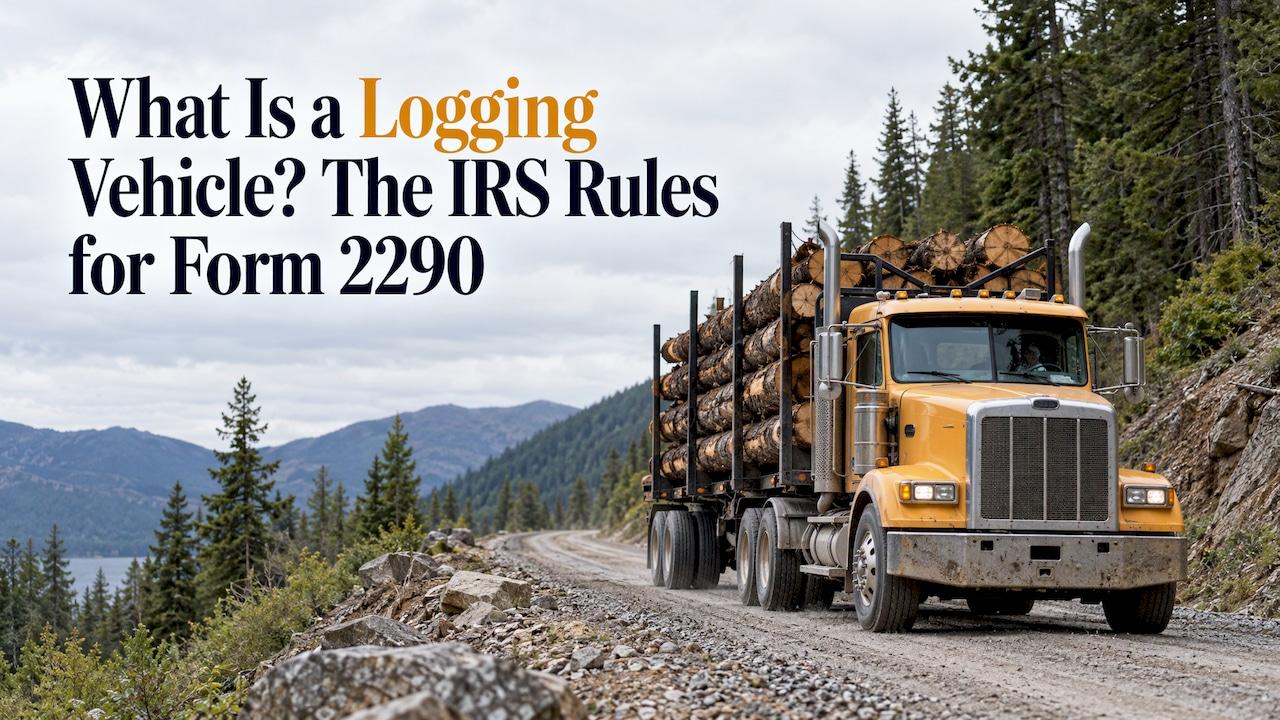
A logging vehicle is a highway truck used only to haul products harvested from a forested site, and registered in your state as a highway motor vehicle used only for hauling harvested forest products. Meet both tests and the IRS cuts your heavy highway vehicle use tax (HVUT) by 25%. This guide explains the definition, what qualifies, what it saves and how to report it on Form 2290.
TL;DR
- A logging vehicle for Form 2290 must be used exclusively to move harvested forest products and must be registered in your state for that exclusive use.
- Qualifying trucks pay a rate 25% lower than the standard rate. For a July first-use truck over 75,000 pounds, that is $412.50 instead of $550.00.
- Using the truck for anything else during the tax period, such as moving equipment, can disqualify it from the reduction.
- Report the truck on Form 2290 using the logging column. You need your EIN, each VIN and each taxable gross weight.
- Fleets with 25 or more taxable vehicles must e-file. A stamped Schedule 1 can be ready within minutes of IRS acceptance.
Table of Contents
- The IRS definition in plain English
- What counts as products harvested from the forested site
- Which trucks qualify, and which don't
- What a logging vehicle pays
- How to report a logging vehicle on Form 2290
- Due dates and the 25-vehicle e-file rule
- Fixing a mistake: VIN corrections and amendments
- Our perspective: logging fleets deserve a filing process that matches their work
- File your logging truck return with TruckTaxPro
- FAQ
- Sources
The IRS definition in plain English
Search for "logging vehicle" and you mostly get videos, equipment listings and photos of log trucks. For tax purposes the question is narrower and more valuable: does the IRS treat your truck as a logging vehicle?
The Instructions for Form 2290 set two conditions. Both must be true:
- Exclusive use. The vehicle is used only to transport products harvested from the forested site. It can also be used only to move those products to and from locations on a forested site. Public highways may be used between forested site locations.
- Exclusive registration. The vehicle is registered, under the laws of the state or states where it must be registered, as a highway motor vehicle used only in transporting harvested forest products.
The federal regulation says the same thing. Under 26 CFR § 41.4483-6, a "truck used in logging" is a highway motor vehicle used exclusively during the taxable period to carry products harvested from a forested site. The rule applies to trips to and from a point on that site. The truck must also carry that exclusive-use registration.
The word that matters most is "exclusively." The reduction is not tied to what the truck looks like. It is tied to what the truck does all year, and to how your state has it registered.
A note on the tax period
The test applies "during the taxable period." Form 2290 runs on a July through June cycle, so a truck's logging status is judged across the period you are paying tax for. Think about the whole year of work before you claim the reduced rate, not just the loads you hauled last week.
What counts as products harvested from the forested site
Most people picture whole logs on a trailer. The rules are a little broader than that.
According to the IRS instructions, harvested products can include timber processed for commercial use by sawing it into lumber, chipping it or other milling operations. The condition is that the processing happens before the product leaves the forested site. So a truck hauling wood chips from a chipper operating on the site can still fit the definition. 26 CFR § 41.4483-6 uses the same wording.

What the definition protects is the link to the forest. The product starts at the forested site, and the truck moves it out of there.
Do you need a special plate?
No. Both the IRS instructions and the regulation say no special tag or license plate identifying a vehicle as used for hauling harvested forest products is required. What counts is that your state registers the vehicle as a highway motor vehicle used exclusively for that purpose, under a state statute or legally valid regulations. If you are not sure how your state records that status, ask your state motor vehicle agency before you claim it.
Which trucks qualify, and which don't
The typical qualifying truck is the one most people call a log truck. Industry descriptions say the log truck is the most common vehicle for moving logs from the woods to the mill, in several configurations. The IRS does not care about the configuration. It cares about the two tests above.
The table shows how the tests play out in practice.
| Situation | Likely treatment | Why |
|---|---|---|
| Tractor and log trailer hauling only harvested timber from the forested site to the mill, registered for that use | Qualifies | Meets exclusive use and exclusive registration |
| Truck hauling wood chips produced on the forested site before leaving it, registered for that use | Qualifies | Processing happened before leaving the forested site |
| Truck used to move equipment as well as timber | Does not qualify | The use is not exclusive |
| Truck hauling wood from a secondary facility such as a wood yard | Does not qualify | The load did not come directly from the forested site |
| Truck that hauls timber but is not registered in your state for that exclusive use | Does not qualify | The registration test is not met |
The last three rows come from the IRS's own reasoning. In memorandum PMTA 2009-153, the IRS says a truck that moves equipment, hauls wood from a secondary facility such as a wood yard, or serves any purpose other than hauling forest products from the site is disqualified from the 25% reduction. The qualification is truck by truck, so one truck in your fleet can qualify while another does not.
Why the reduction exists
The memorandum traces the reduction to the Deficit Reduction Act of 1984. Congress meant to apply a lower rate to registered logging vehicles used only to haul forest products from a point on a forested site. The reduction is deliberate and long-standing, so claiming it correctly is simply using the tax code as written.
What a logging vehicle pays
The tax is cut by 25% for a truck used in logging. Publication 349 says the same, and the numbers below come from the Form 2290 (Rev. July 2026) tax table for vehicles first used in July:
| Weight category | Standard rate | Logging rate |
|---|---|---|
| A (55,000 pounds) | $100.00 | $75.00 |
| V (over 75,000 pounds) | $550.00 | $412.50 |
Publication 349 gives a worked example. A Category V truck has a July tax of $550, but as a logging vehicle the liability is $412.50. That is $137.50 saved on one truck for the year.
For a fleet, the saving multiplies. Ten qualifying Category V trucks first used in July would owe $4,125.00 instead of $5,500.00 at these table rates. Always confirm the figure on the current form, since the rates apply to the July 2026 to June 2027 period.

How to report a logging vehicle on Form 2290
The process is the same as any Form 2290 filing, with the logging rate applied to the qualifying vehicle. Here is the order that keeps errors out.
- Gather your identifiers. Per the IRS instructions, you need your employer identification number (EIN). You cannot use a Social Security number. You also need the VIN of each vehicle and the taxable gross weight of each vehicle.
- Get the VIN from the right place. It can come from the registration, the title or the vehicle itself. It is generally 17 characters, numbers and letters. Use the VIN of the truck, not the trailer.
- Work out taxable gross weight. For a vehicle other than a bus, it is the unloaded weight of the fully equipped vehicle, plus the weight of the load customarily carried, plus the weight of the semitrailer or trailer customarily used with it, according to the instructions. That total sets the category.
- Enter each truck and mark the logging treatment for those that meet both tests.
- File and pay. Once the IRS accepts an e-filed return, the instructions say the stamped Schedule 1 can be available within minutes.
- Print and keep the stamped Schedule 1. Publication 4900 says you present it when registering your vehicle. It also says the watermark on your printed copy must be fully legible before you submit it to your state department of motor vehicles.
If the stamp prints faintly, the IRS Trucking Tax Center suggests reprinting with fresh ink or on a different printer. Filing by mail is slower. The same page says to expect your stamped Schedule 1 within 6 weeks after the IRS receives the return.
Due dates and the 25-vehicle e-file rule
The filing season runs from July 1 through June 30, according to the Trucking Tax Center. Your deadline depends on the month the vehicle is first used on public highways.
- First used in July: file and pay between July 1 and August 31, per the IRS page on when Form 2290 taxes are due.
- First used in another month: the tax is prorated for the months the truck is in service. Form 2290 is due by the last day of the month after the month of first use.
For a logging operation that adds a truck mid-year, the second rule is the one to watch. Our Form 2290 due dates guide walks through the calendar.
Fleet size also decides how you file. The IRS instructions require electronic filing for each return reporting and paying tax on 25 or more vehicles during the tax period. Suspended vehicles (category W) are not counted toward that 25, since you pay no tax on them. The IRS FAQs for truckers who e-file add that filers of 25 or more must use an IRS-approved software provider.
Fixing a mistake: VIN corrections and amendments
Logging fleets swap trucks and trailers often, and typos happen. The IRS treats the two kinds of fix differently, and ticking the wrong box is an easy mistake.
- VIN correction. Per the IRS instructions, check the VIN Correction box and list the corrected VINs on Schedule 1. Use the Form 2290 for the tax period you are correcting and attach a statement explaining the correction. Don't check the box for any other reason. You can start one on our VIN correction page.
- Amended return. Check the Amended Return box only to report additional tax from an increase in taxable gross weight, or suspended vehicles that exceeded the mileage use limit. Don't check it for anything else. Our amendment filing page covers both cases.
A logging truck whose loaded configuration gets heavier during the year is a typical amendment case. Report the new taxable gross weight with an amended return rather than leaving the original figure in place.
Our perspective: logging fleets deserve a filing process that matches their work
Logging crews work from the woods, not from an office. The last thing an owner-operator needs in July is a paper form, a trip to a tax preparer and a six-week wait for a stamped Schedule 1 while a truck sits idle.
That is why we built TruckTaxPro as a mobile-first workflow. You enter your business details and your vehicle information. The platform handles the tax calculation and the IRS validation, and the stamped Schedule 1 arrives in minutes once the IRS accepts the return. Our reported acceptance rate is 99.6%.
Our pricing is flat. A single vehicle filing costs $6.90, and we do not add per-VIN charges. Fleets are priced by vehicle count rather than by a long list of extras, so a logging company running a handful of trucks knows the cost before it starts.
We also built the platform for the corrections that real fleets need. VIN corrections do not add tax, and amendments for weight increases are handled in the same account, with your documents stored digitally for the next time a state office asks for them.
the author
File your logging truck return with TruckTaxPro
If your truck meets both logging tests, you can file Form 2290 online in a few minutes. Enter your EIN, your VINs and your taxable gross weights, and we calculate the tax and validate the return with the IRS. Live status updates show you when it is accepted, and your stamped Schedule 1 comes back in minutes.

Our published prices are:
| Filing | Price |
|---|---|
| 2290 filing, single vehicle | $6.90 per filing |
| 2290 filing, 2 to 24 vehicles | $39.99 per filing |
| 2290 filing, 25 to 100 vehicles | $59.99 per filing |
| 2290 filing, 101 to 500 vehicles | $99.99 per filing |
| 2290 amendment | $29.99 per filing |
| VIN correction | $9.99 per filing |
Start on our Form 2290 e-filing page, or read our first-time filers guide if this is your first return. Our refund policy explains the service terms.
FAQ
Can a truck that sometimes hauls other loads still be a logging vehicle?
Not for the reduced rate. The test is exclusive use during the taxable period. The IRS has said that moving equipment, or hauling wood from a secondary facility such as a wood yard, disqualifies that truck from the 25% reduction (PMTA 2009-153). Dedicate the truck to forest products if you want it to qualify.
Do I need a special license plate for a logging truck?
No. The IRS instructions say no special tag or plate is required. Your state must register the truck as a highway motor vehicle used exclusively to transport harvested forest products. If you are unsure how your registration reads, check with your state motor vehicle agency.
How much less does a logging vehicle pay?
The tax is 25% lower. On the July 2026 Form 2290 table, a truck over 75,000 pounds first used in July pays $412.50 instead of $550.00. A 55,000-pound truck pays $75.00 instead of $100.00.
Do logging companies have to e-file Form 2290?
Only if they report 25 or more taxable vehicles on a return during the tax period, according to the IRS instructions. Smaller fleets can choose to e-file, which gets the stamped Schedule 1 back in minutes instead of weeks. Our Form 2290 e-filing guide shows the steps.
Where do I find the VIN to enter for a log truck?
Use the registration, the title or the vehicle itself. The VIN is generally 17 numbers and letters, and it must be the truck's VIN rather than the trailer's, per the IRS instructions.
Sources
- Instructions for Form 2290 (07/2026), IRS
- Instructions for Form 2290 (Rev. July 2025), IRS
- Form 2290 (Rev. July 2026), IRS
- 26 CFR § 41.4483-6, Reduction in tax for trucks used in logging
- IRS memorandum PMTA 2009-153
- Publication 349, Federal Highway Use Tax on Heavy Vehicles
- Publication 4900, IRS
- Trucking Tax Center, IRS
- When Form 2290 taxes are due, IRS
- FAQs for truckers who e-file, IRS